You are holding your Mounjaro pen, the cap is off, and you are wondering, "Where exactly am I supposed to put this?" as you look down at your tummy.
You are not by yourself. It is one of the most important questions that we might contemplate. In addition to affecting comfort, the injection site can have an impact on how well the drug is absorbed, whether you bruise, and how your body responds to treatment over time.
At a glance
-
Three locations can get injections of Mounjaro (tirzepatide): the back of the upper arms, the front of the thighs, or the abdomen.
-
The abdomen typically provides the quickest and most reliable absorption; most patients also find it to be the most comfortable.
-
To avoid skin irritation and hard lumps (lipohypertrophy), you should switch up the injection site every week.
-
The conventional procedure is to inject at a 90-degree angle into a pinched fold of skin, always into subcutaneous fat rather than muscle.
-
The thigh frequently works better than the stomach if you are on blood thinners or bruise quickly.
The three Mounjaro injection sites
Mounjaro is administered subcutaneously, meaning it enters the fat layer directly beneath the skin rather than a vein or muscle. Three places are approved by Eli Lilly's prescribing information for the medication:
Your abdomen
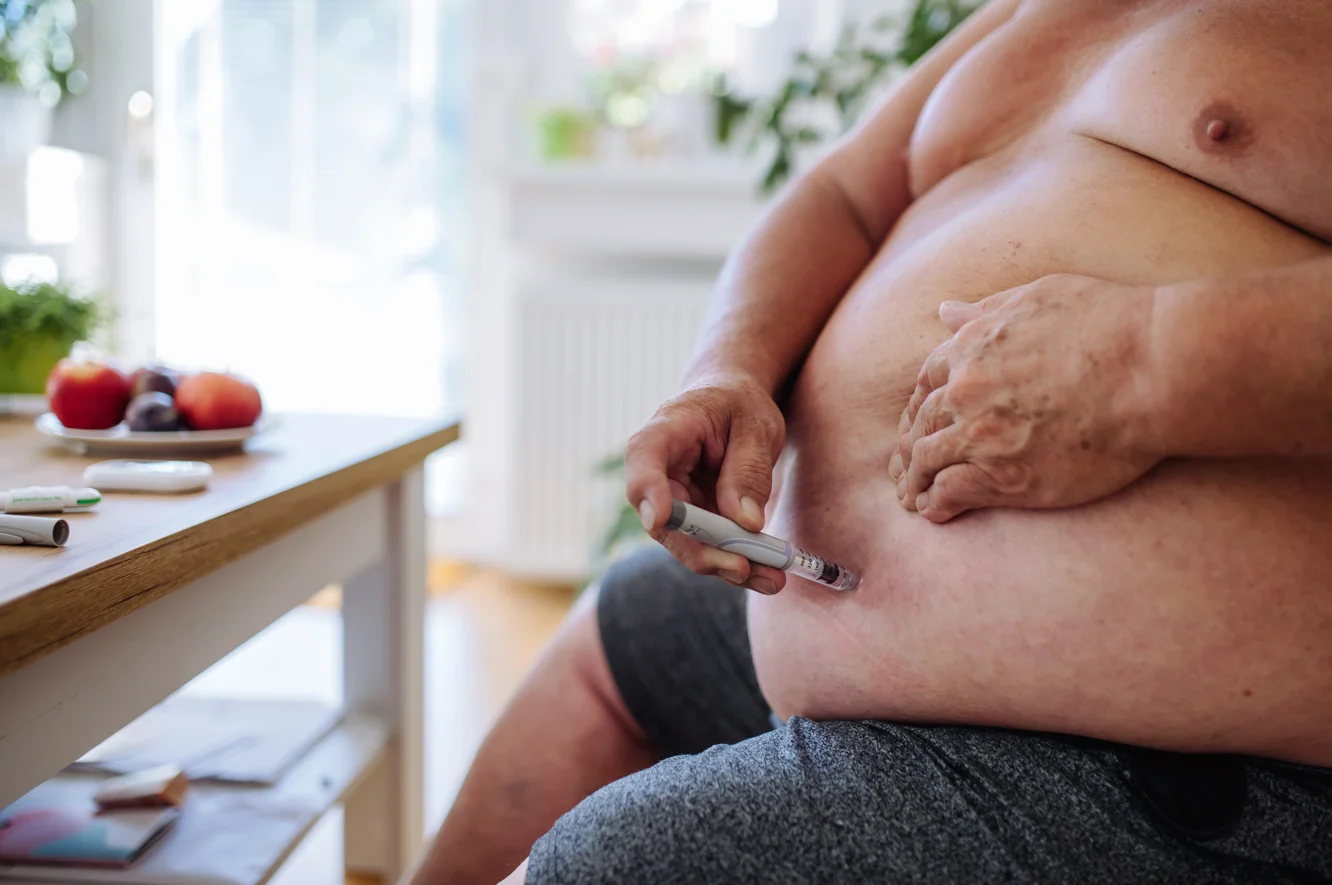
For good reason, this is where most people begin. Most people have a thick layer of subcutaneous fat in the stomach region, which facilitates proper technique.
The most important guideline is to keep your belly button at least 5 cm (2 inches) away. Because the tissue directly surrounding the navel is denser and has a different blood flow, absorption may be impacted and discomfort may increase. You can deal with the whole region above your hips and below your ribs.
Knowing a few specifics worth worth value. Most people have slightly more subcutaneous fat in the lower abdomen (below the navel line), which may make the injection more pleasant. Steer clear of any regions that have visible veins, stretch marks, or scars because they will absorb differently and bruise more readily.
The front of your thighs
Your second alternative is an excellent one, especially if you find stomach injections uncomfortable or are lean in the midsection. Approximately at the middle third between your knee and hip, use the upper, outer part of your front thigh.
The absorption absorption properties are slightly different from the thigh. Research on subcutaneous injections often reveals slightly slower absorption from the thigh than from the belly, but this difference is clinically negligible when tirzepatide is administered once a week. Consistency is more important; choose websites you can utilize consistently every week.
One practical benefit of the practical advantage of the practical advantage of the practical advantage of the practical advantage of the practical advantage of the thigh.
The back of your upper arms
It is challenging to inject yourself here, but the upper arm functions fine. Most individuals find it difficult to pinch the skin and use the pen with one hand, and you need to reach the fleshy area at the back of your arm, roughly between your shoulder and elbow.
If you have a partner, family member, or housemate who is prepared to help, the upper arm is a perfectly good spot. However, the abs and thighs will probably be much more useful if you are doing this alone.
Which injection site is best?
The one you will use all the time.
However, to be more precise, the abdomen provides the optimum balance of comfort, accessibility, and consistency of absorption for the majority of patients. It is the initial suggestion in the majority of clinical guidelines for a reason.
However, we would like you to consider that your body is unique and belongs to you. The thigh may be much more comfortable for someone with very little stomach fat. An individual who is prone to bruises on their stomach may benefit more from treatment on their outer thigh.
Here are several scenarios in which one website might perform better than another:
For many people, the front of the thigh bruises less than the abdomen if you take anticoagulants or bruise quickly. There is typically reduced superficial blood vessel density and thicker skin. Every week, every week, every week, every week.
Find the area where you can most easily pinch a fold of fat between your thumb and forefinger if you are really thin. The thigh will be more comfortable if you are unable to fold your stomach well.
Avoid injecting into any area that is experiencing active flare-ups if you have skin disorders like psoriasis or eczema. Medication absorption is erratic in inflammatory skin, and you will probably experience increased irritation.
How to rotate your injection sites properly
Rotation of the site rotation of the site. Weekly injections into the same location may result in lipohypertrophy, which is characterized by solid lumps of fat beneath the skin. These are not simply cosmetically irritating; they affect absorption. Your dose may not be as effective if you inject medication into lipohypertrophic tissue because it absorbs erratically.
The guidelines are simple: each weekly injection should be administered in a different location, at least two to three centimeters from the previous injection site. You can change the precise location while remaining in the same general area (such as the abdomen).
Here's a practical four-week rotation that works well:
-
Week 1 — right side of abdomen, below the navel
-
Week 2 — left side of abdomen, below the navel
-
Week 3 — right thigh, outer front
-
Week 4 — left thigh, outer front
-
Then repeat
A more straightforward two-site rotation that alternates between the left and right abdomens every week is preferred by others. As long as the precise injection spot is spaced a few centimeters apart each time, that is also OK.
One helpful technique is to have a brief note on your phone. Simply write "right thigh" or "left stomach" after every injection. It saves you the trouble of attempting to recall the next week and only takes three seconds. While some just add it to their calendar entry, others use the Mounjaro app.
Step-by-step: how to inject Mounjaro
In the event that this is your first time. The Mounjaro KwikPen is easy to use and has a very small needle, which most users report as a slight pinch rather than actual pain.
Before you start:
Thirty minutes in advance, remove the pen from the refrigerator. Cold medication can be painful as it enters the tissue and stings more when injected. Do not attempt to reheat it with hot water or a microwave; this could harm the tirzepatide. Instead, let it come to room temperature naturally.
Examine the pen. Examine the solution through the window. It should be transparent, colorless, or faintly yellow. If it is hazy, includes particles, or has changed colour, do not use it.
The injection itself:
-
Use soap and water to wash your hands.
-
Select the injection injection site, and clean, and swab. Injecting through wet alcohol will cause unnecessary stinging, so let it air dry fully.
-
Take off the pen cap. The grey base cap is visible; remove it by twisting it off and pulling it directly away from the pen. This makes the needle visible.
-
At the location of your choice, pinch a skin fold. Lift two to three centimeters of skin and fat from the underlying muscle using your thumb and forefinger. This guarantees that the needle enters subcutaneous tissue rather than muscle.
-
The needle should be inserted at a 90-degree angle to the skin. Because the needle is short and made to reach the proper depth in most body types, push it all the way in.
-
Hold down the injection button. There will be a click. When the dosage is finished, you will hear a second click. Hold the pen against your skin for the entire ten seconds. The grey plunger will be visible in the window.
-
Take the needle out immediately. Avoid rubbing the area as this can exacerbate bruises. Press gently for ten to twenty seconds with a clean cotton pad if there is a tiny drop of blood.
That is all. Once you have done it a few times, the entire process takes less than a minute.
Dealing with bruising, lumps and discomfort
Particularly during the initial weeks when you are honing your technique, some bruising is common. You should not worry about minor bruises that go away in a few days.
To minimise bruising:
Before injecting, let the alcohol swab completely dry. Wet alcohol accelerates bleeding and disturbs the skin's surface. If you are prone to bruising, ice the area for two to three minutes before injecting because this narrows the superficial blood vessels. After injection, avoid rubbing the injection site. Additionally, make sure you are entering at a correct 90-degree angle by checking your technique. More tissue is harmed by angled needle entrance.
Hard lumps beneath the skin indicate lipohypertrophy, which is an indication that you are injecting in the same area too frequently. For at least four to six weeks, stop using that area completely and rotate more carefully. Although the lumps will typically go away on their own, let your doctor know about them as they can have an impact on how well your current dosage is absorbed.
Contact your doctor or chemist if you experience redness, swelling, or warmth that worsens rather than improves over the course of 24 to 48 hours, or if you get a fever. Although injection site infections are uncommon when done correctly, they do occur and require immediate antibiotic treatment.
You should anticipate greater bruising than usual if you take blood thinners (warfarin, apixaban, rivaroxaban, or even daily aspirin). This is normal. Because it usually results in smaller bruises, the thigh is usually a preferable choice. Instead of the typical 10-20 seconds, apply light pressure for a full 30 seconds after extracting the needle. Additionally, you should never inject into a bruised area from a prior injection.